The Power of OSINT in War: You Don’t Need Fancy Tools to Watch a War Unfold in Real Time
Situational awareness doesn’t stop at your front door.
If you’ve been following the news — and if you’re part of this community, you should be — you know that the US, Israel, and Iran are actively engaged in a shooting war right now. Operation Epic Fury kicked off on February 28, 2026, and since then the Middle East has looked like a live-fire exercise with ballistic missiles, drone swarms, and cyberattacks running simultaneously around the clock.
Most people are getting their information from cable news — which means they’re getting it late, filtered, and framed for a passive audience. That’s not how we operate.
The good news: you don’t need a government clearance or a suite of expensive OSINT software to watch this unfold in near real time. You need the same skill you already work on at the range — knowing where to look before you need to.
Why This Matters to You Right Now
Global conflicts have local consequences. We’re already seeing it:
- Fuel prices are spiking. The Strait of Hormuz carries roughly 20% of the world’s oil, and Iran knows it. Vietnam reported a 56% diesel price jump within days of the conflict starting. The US isn’t immune.
- Supply chains are already stressed. Saudi Aramco is talking about “catastrophic consequences” for global oil markets if Hormuz disruptions continue.
- The cyber dimension is real. Hacktivist groups have been hammering Gulf state infrastructure, utilities, and airports — the same threat vectors that hit US critical infrastructure during peacetime. Wartime accelerates everything.
None of this means you need to panic. It means you need to be informed — and informed people make better decisions. That’s the whole point of training.
Monitor the Conflict Without Specialized Tools
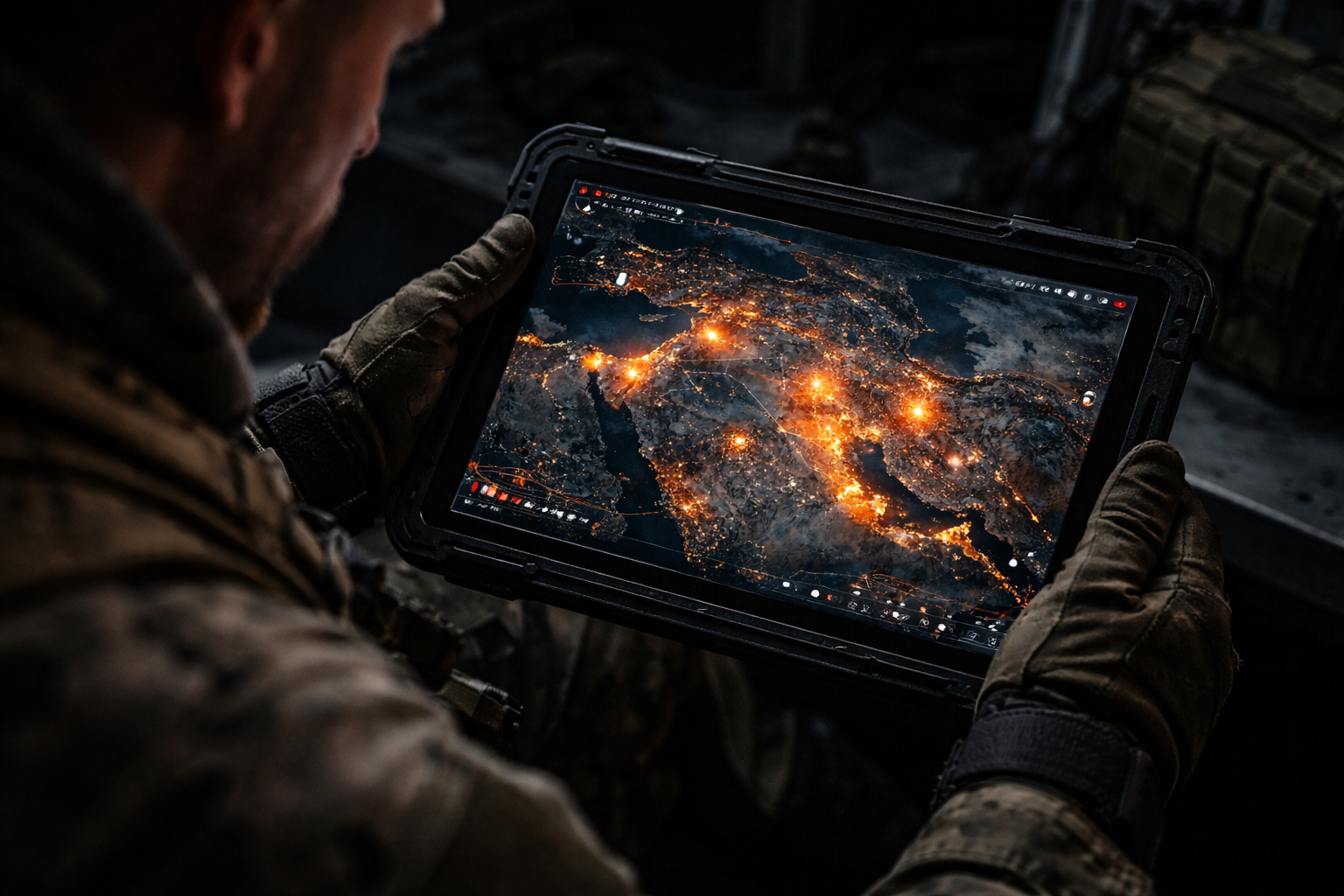
You don’t need to pay for an OSINT platform subscription. Here’s a clean, no-cost monitoring workflow built on publicly available sources.
Start With a Live Map
iran.liveuamap.com is probably the single most useful free resource right now. It geolocates reported incidents — strikes, intercepts, missile launches — onto an interactive map updated continuously. It’s not perfect, and not every claim is verified, but it gives you a ground-level picture of where things are happening that no news broadcast matches.
Check this first when you see a headline. The map will often show you what the news anchor is still typing about.
Watch the Airspace
Flightradar24 (free, browser-based) shows commercial air traffic in real time. Here’s the tactical insight: when major airspace closes suddenly — over Iran, the Gulf states, or the eastern Mediterranean — that’s often the first public signal that something kinetic just happened or is about to. Airlines don’t ground international routes because of rumors.
When Flightradar24 shows a blank zone where there should be traffic, that’s your cue to dig deeper.
Use ADS-B Exchange for Military Signals
ADS-B Exchange (also free, browser-based) is the unfiltered version. Unlike FlightRadar24, it doesn’t remove aircraft at government request. That means you can sometimes see ISR (intelligence, surveillance, and reconnaissance) aircraft in sustained orbits over a region — a pattern that consistently precedes or accompanies ground action.
It won’t show everything. But what it does show, it shows honestly.
Track the Cyber Front
Kinetic warfare and cyber warfare are now running in parallel. On February 28, coordinated cyberattacks drove Iran’s internet connectivity to roughly 4% of normal levels at the same time the airstrikes began. Major Iranian state media outlets were taken offline precisely when Iran’s leadership needed communications most.
SOCRadar’s Iran-Israel Cyber Conflict Dashboard aggregates hacktivist claims, DDoS activity, and confirmed infrastructure attacks. It’s targeted enough to be useful and updated frequently enough to track operational tempo.
Check Internet Connectivity as a Real-Time Indicator
This one is underutilized. When a country’s internet suddenly degrades — especially a state like Iran that controls its own infrastructure — it’s either an inbound attack or a government-imposed blackout ahead of something they don’t want the world to see in real time.
NetBlocks.org tracks internet outages and connectivity disruptions globally. Bookmark it. When you see Iran go dark or the UAE’s connectivity spike with anomalies, that’s signal worth paying attention to.
Read the Social Layer — But Verify Before You Trust It
Telegram is where a lot of the early information surfaces — from IRGC propaganda channels, hacktivist groups, and regional journalists. It’s also where a significant portion of the misinformation originates. University of Washington research on past conflicts has found that large “OSINT” social accounts often have far fewer editorial safeguards than traditional media while reaching far more people.
The rule is the same as it is on the range: slow down to speed up. A claim that arrives fast and unverified is a miss until it’s confirmed. Cross-reference anything significant against at least two independent sources before you repeat it or act on it.
The Takeaway
You already understand that situational awareness is a perishable skill. You practice it when you’re out in public, in your vehicle, at the range. What we’re talking about here is the same mindset scaled up — watching the strategic environment the way you watch the room you just walked into.
You don’t need a PhD in geopolitics or a $500/month intelligence platform. You need a handful of reliable free tools, the discipline to check them regularly, and the critical thinking skills to separate signal from noise.
The world is not getting quieter. But prepared people have options that the uninformed don’t.
Train accordingly.
-Bryan L Singer, USCCA Instructor, CISSP, CAP, CPIN, GRID
Bryan Singer is the founder and lead instructor at Sierra Bravo on Target, conducting most of his training at Doubletap Training Grounds in Calera, Alabama. A veteran of the US Army’s 525th Military Intelligence Brigade, 1st Armored Division, and 1st Infantry Division, Bryan spent eight years developing the analytical instincts and threat-assessment discipline that now define his teaching. He has been a competitive and defensive shooter for over 40 years, and has spent more than three decades as a recognized expert in cybersecurity, critical infrastructure protection, and industrial control systems security.
His entire career — in uniform and out — has been built around one core principle: risk management in both the physical and digital world. Whether he’s behind the firing line or advising organizations on securing operational technology, the framework is the same: read the environment, understand the threat, and respond with precision.
Bryan writes about self-defense, tactical mindset, kinesics and body language, and what it means to stay prepared in an increasingly complex world.