
Why You Fall Apart When It Matters Most
Most of us watched it happen in real time last Friday in Milan: Ilia Malinin — the “Quad God,” three-time world champion, the overwhelming favorite for Olympic gold — stood at center ice and fell apart. Two falls, two abandoned quad attempts, an eighth-place finish, and afterward he described what any serious shooter who has ever blanked on a draw stroke will immediately recognize: “All the traumatic moments of my life really just started flooding my head. So many negative thoughts that I could not handle it.” That’s not a skating problem. That’s de-automation — and it happens in every high-stakes physical discipline, including yours.
The Science of Falling Apart
Your draw stroke was flawless at the range. Your grip, your index, your trigger press — all of it smooth and automatic. So why, when the buzzer screamed or the situation turned real, did your hands forget everything they knew?
There is a particular kind of failure that haunts serious shooters. It doesn’t happen when you’re relaxed and alone on a Tuesday afternoon, punching tight groups from the fifteen-yard line with no one watching. It happens at the worst possible moment — in a competition stage, a force-on-force drill, or in the cold arithmetic of a real confrontation — when the skills you’ve drilled thousands of times simply vanish. Your draw becomes a fumble. Your trigger press becomes a yank. You miss targets you could make in your sleep. What happened?
Psychologists have a name for this. They call it reinvestment — and understanding it might be the most important thing a serious defensive shooter can do.
The Automation Miracle (and Its Fragility)
When you first learned to draw from a holster, it was an act of conscious labor. You thought about every micro-step: thumb the retention, rotate the muzzle, drive the gun out, meet your support hand, find the sight picture. Each movement competed for your attention like a crowd of anxious students all raising their hands at once. You were slow. You were stiff. Every rep felt like translating a foreign language in real time.
But something happened over thousands of repetitions. The prefrontal cortex — the brain’s deliberate, analytical engine — gradually handed the controls to the basal ganglia and cerebellum, the deep structures that run motor programs below the level of conscious thought. The draw became a chunk: a single, compressed behavioral unit that fires as one gesture. You stopped thinking about it. That’s exactly what you wanted. That is the miracle of motor learning.
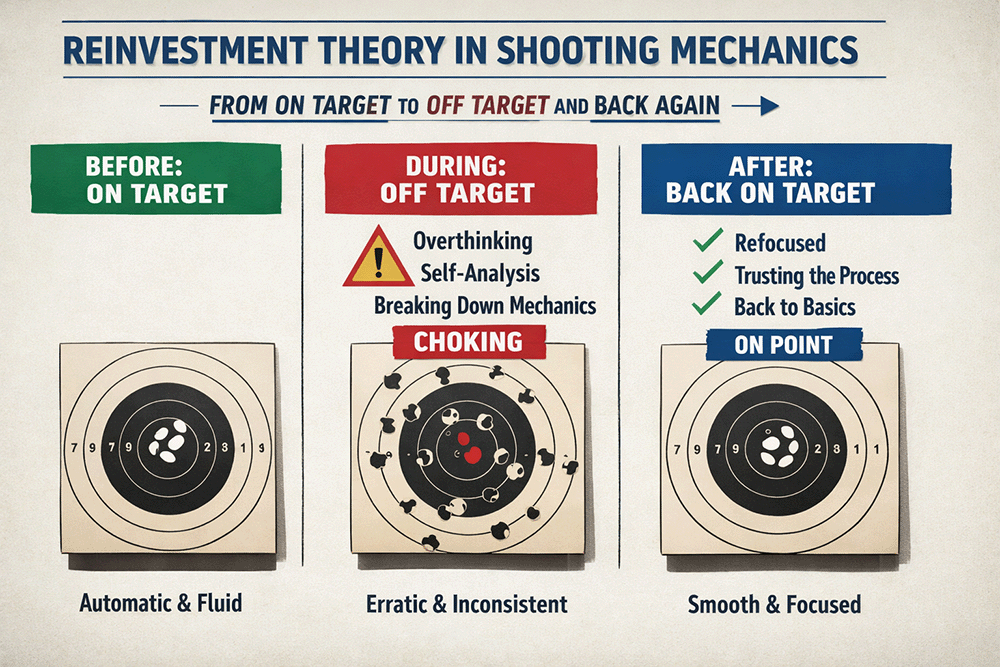
Sports scientists Richard Masters and Jonathan Maxwell spent decades studying what happens next. Their finding: conscious attention, under pressure, reaches back down into that automated program and breaks it apart. The very act of monitoring your own movement — of thinking about what your hands are doing — reassembles the mental assembly line you worked so hard to dissolve. Your draw becomes a sequence again, not a gesture. And sequences, under stress, collapse.
“Skill is nothing more than automation on loan. Pressure is the landlord. And the landlord always comes to collect.”
— Masters & Maxwell, on reinvestment theory
This is why technically excellent shooters — people who look sublime in dry fire, who clean classifier after classifier in practice — sometimes fall apart in front of an audience or when stakes are introduced. The pressure doesn’t destroy their skill. It de-automates it. It drags the skill back up into the slow, fragile, bandwidth-limited conscious mind, where it was always weak.
The Range Is Lying to You
The conventional range environment is, in a very specific sense, a machine for producing false confidence. You arrive. You load up. You know exactly what you’re going to shoot, when you’re going to shoot it, and more or less where you’re going to stand. The environment is quiet. The social stakes are low. The outcomes are impermanent. No one is threatening you. Nothing is moving.
Under those conditions, your automated skills run beautifully. The basal ganglia handles the whole transaction. You feel competent — because you are competent, in that environment, under those conditions.
Now introduce a shot timer. A class of peers. An instructor watching. A stage you haven’t seen before. A time limit. A failure condition. Any of these, individually, can begin the process of de-automation. Together, they can strip a trained shooter down to the mechanical uncertainty of a first-day student.
Reinvestment Theory
Reinvestment Theory holds that when performers experience anxiety or heightened self-monitoring, they consciously reinvest attention into automated motor programs — disrupting the very execution they’re trying to improve. The shooter who thinks “grip tighter” in the middle of a draw has already begun to fail.
This isn’t weakness. This is biology. The stress response that floods your system during a real threat — cortisol, norepinephrine, the whole sympathetic nervous system alarm cascade — was not designed to help you shoot a pistol. It was designed to move you away from a predator. It tunnels your vision, narrows your cognition, and switches your brain to threat-management mode. The prefrontal cortex, your source of fine-motor coordination and technical precision, goes partially offline. Conscious attention spikes. And conscious attention, as we’ve seen, is poison to automated skill.
The Olympic Problem
You might wonder what any of this has to do with elite performance — with people who have trained more than anyone reading this blog, who have more reps than seems possible, who dedicate their lives to a single physical skill. The answer is: everything.
Consider what research on elite athletes consistently shows. Athletes who score high on what Masters calls “reinvestment propensity” — a personality trait measuring the degree to which a person monitors their own movements during execution — are significantly more likely to choke under pressure than athletes with equivalent technical skill but lower reinvestment propensity. The choking isn’t about physical ability. It’s about where attention goes when the situation gets loud.
And here is the deeply uncomfortable truth for defensive shooters: reinvestment propensity tends to increase with stakes. The situations where your life or someone else’s depends on your technical execution are precisely the situations most likely to drag your attention down into your own movement. The gun you’ve drawn a hundred thousand times starts to feel strange in your hand. The trigger feels different. Your grip feels wrong. And now you’re thinking about your grip, which means your grip is already failing.
Training Out of the Problem — Or Into It
Most firearms training doesn’t address this at all. The model is simple: repetition creates automation, and automation is the goal. And that’s partially true. Repetition does create automation. But it does not create automation that is robust to stress. For that, you need something different.
Masters and his colleagues identified something surprising in their research. Athletes who learned motor skills implicitly — through analogy, through external focus, through constrained practice environments that prevented the formation of explicit verbal rules — were significantly more resistant to reinvestment under pressure than athletes who learned the same skills explicitly, through step-by-step instruction.
Think about what that means for how we teach shooting. The standard curriculum is deeply explicit. We verbalize every step. We name every sub-component. We build a rich, articulate, verbal model of the skill in the student’s mind. That model helps them learn — and it becomes the architecture of their collapse under pressure, because it gives their anxious conscious mind exactly the vocabulary it needs to interfere.
Implicit learning, by contrast, builds the program without building the verbal scaffolding. The student develops the movement without developing a rich conscious model of it. Under pressure, the conscious mind reaches for the blueprint and finds — nothing. There’s nothing to reinvest. The skill keeps running.
What This Means for Your Training
None of this means you should stop drilling, stop getting reps, or abandon technical instruction. It means you need to think seriously about when technical instruction ends and pressure inoculation begins, and how you structure the latter to build the kind of automation that doesn’t unravel when something real is on the line.
Here’s a framework worth internalizing:
“The goal of training is not to make you good under ideal conditions. Ideal conditions don’t exist when it matters. The goal is to make your skill robust to the worst conditions you’ll ever face.”
The Hardest Part
The hardest part of all of this isn’t the training methodology. It’s the ego. Serious shooters — especially experienced ones — are often deeply invested in their technical self-model. They know what they do and why. That knowledge is part of their identity. The idea that this very self-knowledge, this fluency in their own mechanics, is a vulnerability rather than an asset is genuinely threatening.
But it’s true. The shooter who has silenced the inner commentator, who has transcended the need to think about shooting while shooting, who can execute under catastrophic stress as if alone on a Tuesday afternoon — that shooter didn’t get there by drilling more. They got there by understanding the architecture of failure and systematically refusing to build it in.
The gun doesn’t care how much you’ve trained. Under pressure, the only thing that matters is what your training has actually built — not in your memory, not in your verbal self-model, but in the deep structures of the motor system, below thought, below language, below fear.


