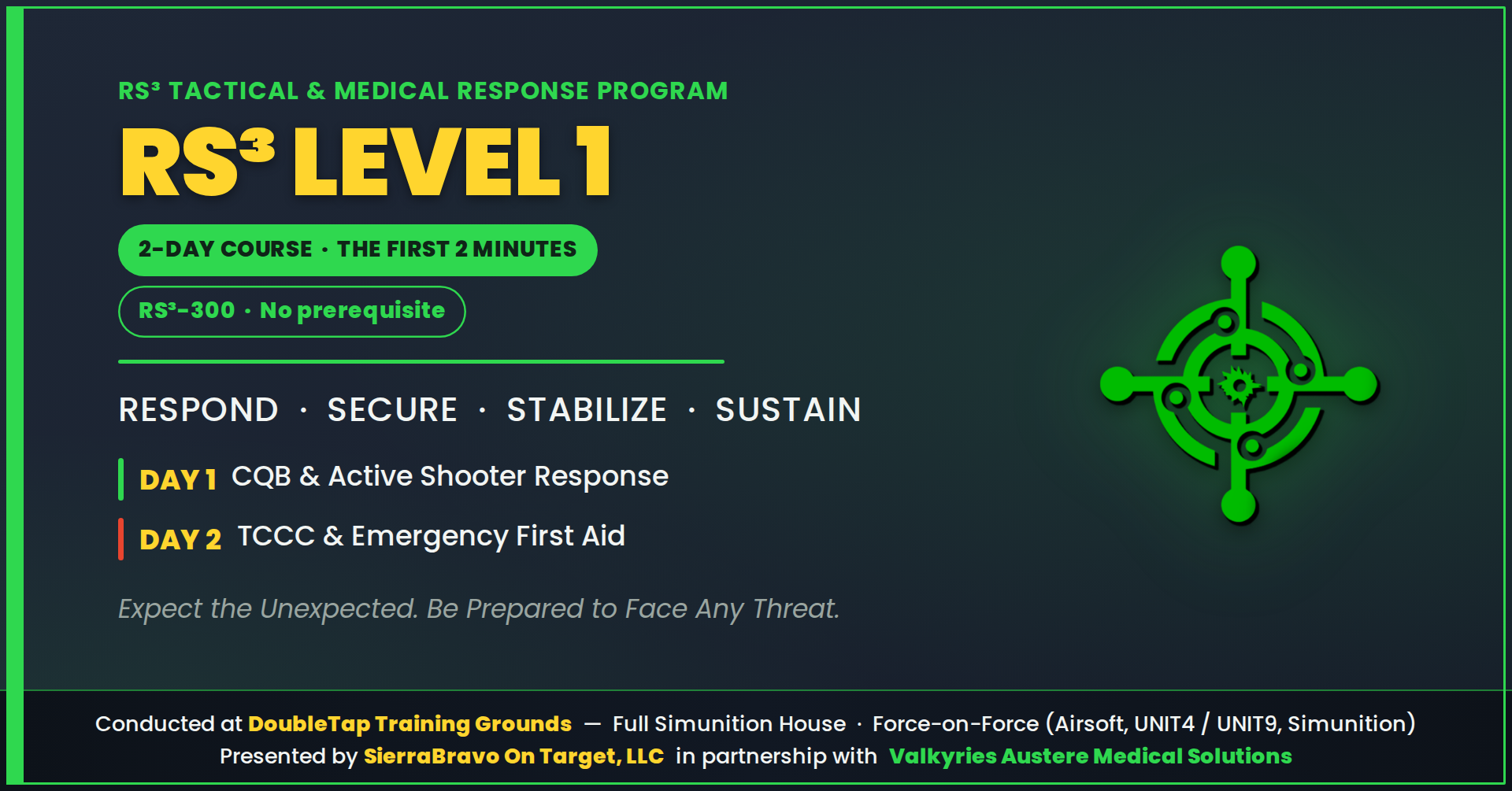
RS³ (RS3-300) Level 1 — The First Two Minutes of an Active Shooter Response
RS³ Level 1 — The First Two Minutes
Two days. Sixteen contact hours. $575. No prerequisite. DoubleTap Training Grounds · Calera, Alabama
Two clocks start at the same instant.
The tactical clock — is it over, is there another one, where is my family. And the medical clock — someone is bleeding, and a person bleeding severely can die from blood loss in about five minutes.
Almost all civilian training addresses the first clock only. You are sent to a range for the fight and, if you are unusually diligent, to a classroom for the medicine — and never taught to run both under pressure, in sequence, as one event. RS³ Level 1 trains both. It is the first rung of a four-level ladder built around an expanding clock: two minutes, five minutes, twenty minutes, one hour.
DAY ONE — TACTICAL
Situational awareness and a usable color code
Pre-attack indicators and threat recognition
Space, angles, and time
CQB fundamentals for a civilian's actual job — not room clearing, but understanding structure well enough to move to your family, hold a doorway, or avoid a fatal funnel
Immediate action under force-on-force in a two-story reconfigurable shoot house, using marking cartridges with certified protective equipment
DAY TWO — MEDICAL
Taught by Valkyries Austere Medical Solutions.
TCCC and emergency first aid foundations
Massive hemorrhage control — tourniquets and wound packing, to repetition
Airway and breathing basics
The MARCH framework, introduced
WHAT YOU LEAVE WITH
You leave able to recognize a developing threat and act decisively in the seconds that decide the outcome — and able to stop a life-threatening bleed.
BUILT ON THE SAME COMMAND STRUCTURE THE PROFESSIONALS USE
RS³ is organized on the Incident Command System — ICS — the framework American emergency services use to run every major incident in the country.
If you have not encountered it, here is what it is. The Incident Command System is a standardized, on-scene, all-hazards approach to managing an emergency. It came out of the California wildfires of the 1970s, where the problem was never a shortage of firefighters — it was that agencies arriving from different jurisdictions used different words, different rank structures, and different assumptions, and could not work together fast enough. ICS fixed that by standardizing how any incident gets organized, regardless of size, cause, or who shows up. It is now a core component of the National Incident Management System (NIMS), the national framework administered by FEMA, and it is what your local police, fire, and EMS run on. Hospitals, school districts, and utilities use it too.
ICS is not a set of tactics. It is a set of management characteristics — common terminology, management by objectives, manageable span of control, the establishment and transfer of command, designated incident facilities. Those characteristics do not change when the incident is small. They just get performed by fewer people.
In the first minutes of a violent event, that is exactly your situation. You are the entire incident organization — incident commander, operations, and medical branch, all at once — and you are going to hand that incident off to professionals who arrive expecting an ICS structure.
At Level 1, you are a single responder. This course teaches the ICS characteristics that apply when there is only one of you: establishment of command — recognizing that someone is in charge of this incident and that right now it is you, and acting rather than waiting; management by objectives — picking the objective that matters in this ten seconds rather than trying to solve the whole event at once, which is the difference between deliberate action and freezing; and common terminology — using the same plain words responding agencies use. FEMA's own guidance is to use clear text: plain English, no codes, no jargon. That is a trained skill under adrenaline, and we train it.
Why we built it this way rather than inventing our own system:
It is the language the people arriving already speak. The most dangerous ninety seconds of an armed citizen's day may be the ninety seconds when law enforcement arrives and does not know who you are. A structured handoff works because it is the format they are trained to receive.
It scales without changing. The same structure governs one person in a hallway and a nine-person church safety team across a campus.
It is auditable. Numbered units, published learning objectives, defined contact hours, performance-based evaluation. That matters when a church board, school administrator, HR director, or insurance carrier has to review the training your team took.
It is not proprietary, so it is testable. We adopted the framework emergency management already uses instead of inventing one and naming it after ourselves.
The curriculum is also NFPA 3000-informed (the standard for Active Shooter/Hostile Event Response) and TCCC/TECC-based.
RS³ is ICS-aligned, not ICS-accredited.
RS³ is not a FEMA course. SierraBravo On Target, LLC is not affiliated with, endorsed by, or accredited by FEMA, the Emergency Management Institute, or any federal, state, or local emergency management agency. Completing an RS³ course confers no FEMA, NIMS, or ICS credential, certification, qualification, or continuing-education credit of any kind. RS³ certificates document contact hours and content covered — nothing more.
If you want actual ICS certification, FEMA offers it directly and most of it is free. ICS-100 and ICS-200 are available online through FEMA's Emergency Management Institute; ICS-300 (Intermediate ICS for Expanding Incidents) and ICS-400 (Advanced ICS for Command and General Staff) are delivered in person through state emergency management agencies. We encourage it, and it pairs well with this program. Start at training.fema.gov.
WHO THIS IS FOR
Responsibly armed citizens who want capability past the permit class. Church and school safety team members. Anyone who has taken a basic class, suspects it was not enough, and cannot find the next rung.
We do not train civilians to act as law enforcement. We train them to protect people and survive until professionals arrive.
PREREQUISITES
None. Students must be 19 or older (16–17 with an enrolled parent or guardian and a signed guardian waiver) and must be able to safely and independently operate their rifle and pistol — load, unload, carry, and shoot without supervision. This is not a fundamentals-of-marksmanship course. All participants sign a liability waiver.
REQUIRED EQUIPMENT
AR-platform rifle with sling; 3 or more magazines; pistol with belt-mounted holster covering the trigger guard; eye and ear protection (electronic muffs recommended); approximately 100 rifle and 100 pistol rounds; hydration; weather-appropriate clothing and closed-toe footwear with tread; brimmed hat; notebook. Knee pads recommended. Protective equipment and marking cartridges for force-on-force are provided.
PHYSICAL EXPECTATIONS
Standing and moving for most of two days, transitions to and from the ground, stairs, and outdoor Alabama weather. Students may opt out of specific movements for injury or medical reasons; modifications preserving the learning objective are provided without penalty. Contact us before class if you have concerns.
CLASS SIZE
Capped at 20. Force-on-force and the instructor-to-student ratio set the cap, not marketing. When it is full, registration closes.
CANCELLATION AND WEATHER
Full refund for cancellations 14 or more days before the course. Within 14 days, the seat transfers to any RS³ course within twelve months. If SierraBravo On Target cancels, students choose a full refund or a transferred seat. We train in rain; we suspend for lightning and unsafe conditions and reschedule or make up lost blocks.
WHAT COMES NEXT
Level 1 is the prerequisite for RS³ Level 2 — The First Five Minutes (RS³-301). The full four-level pathway runs Level 1 through Level 4 across eight training days.
Capability without discipline is liability.
This is a multi-day event
Each session spans multiple days. When you register, you are signing up for all days within that session. Attendance on every scheduled day is required to complete the training.
Schedule
Sat, Nov 14 & Sun, Nov 15, 2026
Venue
Double Tap Training Grounds
300 Horton Cove Road, Calera, AL, 35040
In personTickets
Next session: Sat, Nov 14, 2026